Thursday, December 28, 2006

Charles Town Christmas Bird Count: 53-Year Summary

The Charles Town Christmas Bird Count (CBC) is located in Jefferson County, West Virginia; it is one of two CBCs in the Eastern Panhandle of West Virginia, the other being Inwood. The count was initiated in the winter of 1952-1953 and, with the lone exception of 1967-1968, it has been conducted annually, yielding a total of 53 counts through the winter of 2005-2006. The following is an example of the convention used to summarize the frequency of occurrence and abundance of each species recorded in these 53 years:

Tufted Titmouse 53 (144, 84, 49, 18, 2)

In this example,
  • 53 is the number of years in which Tufted Titmouse was recorded,
  • 144 is the maximum count,
  • 84 is the 75th percentile count,
  • 49 is the median count,
  • 18 is the 25th percentile count, and
  • 2 is the minimum count.
  • A nominal total of 147 species has been recorded on the Charles Town CBC. Based on varying patterns of frequency and abundance, these 147 species are here arranged in five categories (described more fully in following paragraphs):
  • Regular Winter Residents (61 species)
  • Rare Winter Residents or Visitors (24)
  • Extremely Rare Winter Residents or Visitors (16)
  • Extremely Vagrants (24)
  • Accidental Vagrants 22)
  • Regular Winter Residents (frequency of at least 50 percent and median abundance of at least 1 bird/count). Of the 4,523 individuals of 61 species recorded annually (on average), 82 percent are passerines (36 species), 58 percent are introduced (4 species), 9 percent are hunted gamebirds (8 species), 4 percent are waterbirds (10 species), and 1 percent are raptors or scavengers (7 species). Species are arranged in decreasing order by median, 75th percentile, and maximum counts.
  • European Starling 53 (14484, 2893, 1868, 540, 212)
  • American Crow 53 (7500, 1900, 488, 250, 107)
  • Rock Pigeon 32 (1171, 471, 262, 0, 0)
  • House Sparrow 52 (4104, 541, 250, 201, 0)
  • Mourning Dove 49 (1097, 434, 234, 37, 0)
  • Dark-eyed Junco 53 (853, 318, 180, 34, 10)
  • Northern Cardinal 53 (368, 239, 164, 57, 12)
  • White-throated Sparrow 53 (384, 202, 115, 19, 1)
  • Mallard 52 (444, 177, 112, 40, 0)
  • Carolina Chickadee 53 (180, 109, 72, 28, 9)
  • American Goldfinch 53 (266, 131, 71, 30, 2)
  • White-crowned Sparrow 53 (196, 102, 68, 44, 2)
  • Northern Mockingbird 52 (237, 104, 56, 22, 0)
  • Tufted Titmouse 53 (144, 84, 49, 18, 2)
  • Song Sparrow 53 (123, 74, 47, 32, 8)
  • Blue Jay 51 (241, 88, 42, 6, 0)
  • Downy Woodpecker 53 (112, 64, 40, 12, 4)
  • House Finch 32 (388, 161, 31, 0, 0)
  • Red-bellied Woodpecker 52 (88, 48, 28, 4, 0)
  • American Tree Sparrow 52 (153, 55, 27, 12, 0)
  • Carolina Wren 50 (82, 49, 26, 4, 0)
  • White-breasted Nuthatch 52 (63, 28, 20, 7, 0)
  • Eastern Bluebird 44 (256, 54, 19, 10, 2, 0)
  • American Black Duck 42 (155, 39, 19, 0, 0)
  • Turkey Vulture 52 (318, 47, 18, 8, 0)
  • Cedar Waxwing 42 (674, 90, 16, 2, 0)
  • Northern Bobwhite 42 (100, 28, 16, 3, 0)
  • Rusty Blackbird 38 (222, 42, 15, 0, 0)
  • Northern Flicker 48 (63, 30, 15, 3, 0)
  • Killdeer 46 (70, 25, 15, 7, 0)
  • Canada Goose 30 (1624, 366, 12, 0, 0)
  • Common Grackle 42 (6215, 41, 12, 2, 0)
  • Golden-crowned Kinglet 50 (54, 22, 11, 3, 0)
  • Red-tailed Hawk 44 (70, 27, 8, 1, 0)
  • Wilson’s Snipe 42 (41, 17, 8, 1, 0)
  • Belted Kingfisher 52 (24, 13, 8, 4, 0)
  • Brown Creeper 50 (25, 12, 8, 3, 0)
  • Brown-headed Cowbird 53 (2247, 43, 7, 4, 1)
  • Pileated Woodpecker 47 (45, 14, 7, 1, 0)
  • American Kestrel 49 (24, 13, 7, 1, 0)
  • Great Blue Heron 44 (26, 12, 7, 2, 0)
  • Eastern Meadowlark 46 (100, 17, 6, 2, 0)
  • Hooded Merganser 35 (62, 13, 4, 0, 0)
  • Hairy Woodpecker 51 (30, 8, 4, 2, 0)
  • Black-capped Chickadee 34 (221, 23, 3, 0, 0)
  • Red-winged Blackbird 32 (255, 20, 3, 0, 0)
  • Horned Lark 33 (105, 20, 3, 0, 0)
  • Field Sparrow 41 (30, 11, 3, 1, 0)
  • Yellow-bellied Sapsucker 40 (21, 7, 3, 1, 0)
  • American Robin 42 (1476, 28, 2, 1, 0)
  • Black Vulture 29 (126, 13, 2, 0, 0)
  • Pied-billed Grebe 35 (11, 5, 2, 0, 0)
  • Ruby-crowned Kinglet 43 (13, 3, 2, 1, 0)
  • Purple Finch 27 (66, 4, 1, 0, 0)
  • Yellow-rumped Warbler 30 (36, 4, 1, 0, 0)
  • Common Goldeneye 32 (25, 4, 1, 0, 0)
  • Winter Wren 33 (22, 3, 1, 0, 0)
  • Swamp Sparrow 29 (12, 3, 1, 0, 0)
  • Red-shouldered Hawk 32 (15, 2, 1, 0, 0)
  • Loggerhead Shrike 30 (7, 2, 1, 0, 0)
  • Northern Harrier 36 (5, 2, 1, 0, 0)
  • Rare Winter Residents or Visitors (frequency of 25-49 percent and median abundance of less than 1 bird/count). These 24 species may occur annually. Their low frequency of occurrence may be due to small numbers, restricted distributions, or secretive habits. Species are arranged in decreasing order by 75th percentile and maximum counts, and years recorded.
  • Common Merganser 26 (68, 6, 0, 0, 0)
  • American Coot 20 (99, 5, 0, 0, 0)
  • Bufflehead 25 (47, 4, 0, 0, 0)
  • American Wigeon 18 (29, 3, 0, 0, 0)
  • Eastern Screech-Owl 23 (36, 2, 0, 0, 0)
  • Green-winged Teal 15 (34, 2, 0, 0, 0)
  • Fish Crow 19 (29, 2, 0, 0, 0)
  • Ring-necked Pheasant 23 (26, 2, 0, 0, 0)
  • Great Horned Owl 25 (8, 2, 0, 0, 0)
  • Sharp-shinned Hawk 26 (7, 2, 0, 0, 0)
  • Eastern Towhee 21 (7, 2, 0, 0, 0)
  • Wild Turkey 13 (101, 1, 0, 0, 0)
  • Fox Sparrow 18 (96, 1, 0, 0, 0)
  • Evening Grosbeak 13 (40, 1, 0, 0, 0)
  • Wood Duck 16 (28, 1, 0, 0, 0)
  • Ring-billed Gull 19 (16, 1, 0, 0, 0)
  • Pine Siskin 15 (14, 1, 0, 0, 0)
  • Hermit Thrush 18 (10, 1, 0, 0, 0)
  • Cooper’s Hawk 21 (8, 1, 0, 0, 0)
  • Common Raven 18 (6, 1, 0, 0, 0)
  • Red-headed Woodpecker 17 (6, 1, 0, 0, 0)
  • Eastern Phoebe 18 (5, 1, 0, 0, 0)
  • Barred Owl 17 (5, 1, 0, 0, 0)
  • Red-breasted Nuthatch 14 (5, 1, 0, 0, 0)
  • Extremely Rare Winter Residents or Visitors (frequency of 10-24 percent). The occurrence of these 16 species in any given year may be strongly influenced by local weather conditions, particularly by snow cover and the availability of open water. Species are arranged in decreasing order by maximum counts and years recorded.
  • Virginia Rail 9 (114, 0, 0, 0, 0)
  • Canvasback 7 (30, 0, 0, 0, 0)
  • Ruddy Duck 9 (25, 0, 0, 0, 0)
  • Lesser Scaup 12 (23, 0, 0, 0, 0)
  • Ring-necked Duck 10 (21, 0, 0, 0, 0)
  • Chipping sparrow 9 (16, 0, 0, 0, 0)
  • Gadwall 10 (11, 0, 0, 0, 0)
  • Northern Pintail 7 (10, 0, 0, 0, 0)
  • Herring Gull 12 (7, 0, 0, 0, 0)
  • Bald Eagle 10 (7, 0, 0, 0, 0)
  • Horned Grebe 10 (5, 0, 0, 0, 0)
  • Ruffed Grouse 7 (4, 0, 0, 0, 0)
  • Vesper Sparrow 7 (4, 0, 0, 0, 0)
  • Common Loon 8 (3, 0, 0, 0, 0)
  • Rough-legged Hawk 7 (2, 0, 0, 0, 0)
  • Gray Catbird 6 (2, 0, 0, 0, 0)
  • Extremely Rare Winter Vagrants (frequency of less than 10 percent). These 24 species are considered to be outside their normal winter ranges. Some may represent late-fall stragglers. Species are arranged in decreasing order by maximum counts, years recorded, and phylogenetic sequence.
  • Snow Goose 5 (22, 0, 0, 0, 0)
  • Red-breasted Merganser 4 (6, 0, 0, 0, 0)
  • Northern Shoveler 5 (4, 0, 0, 0, 0)
  • Blue-winged Teal 4 (4, 0, 0, 0, 0)
  • Tundra Swan 4 (3, 0, 0, 0, 0)
  • Broad-winged Hawk 3 (3, 0, 0, 0, 0)
  • Mute Swan 2 (3, 0, 0, 0, 0)
  • American Pipit 2 (3, 0, 0, 0, 0)
  • Brown Thrasher 4 (2, 0, 0, 0, 0)
  • Lincoln’s Sparrow 4 (2, 0, 0, 0, 0)
  • Peregrine Falcon 2 (2, 0, 0, 0, 0)
  • Lesser Yellowlegs 2 (2, 0, 0, 0, 0)
  • American Woodcock 3 (1, 0, 0, 0, 0)
  • Merlin 3 (1, 0, 0, 0, 0)
  • House Wren 3 (1, 0, 0, 0, 0)
  • Pine Warbler 3 (1, 0, 0, 0, 0)
  • Savannah Sparrow 3 (1, 0, 0, 0, 0)
  • Green Heron 2 (1, 0, 0, 0, 0)
  • Spotted Sandpiper 2 (1, 0, 0, 0, 0)
  • Dunlin 2 (1, 0, 0, 0, 0)
  • Long-eared Owl 2 (1, 0, 0, 0, 0)
  • Short-eared Owl 2 (1, 0, 0, 0, 0)
  • Blue-gray Gnatcatcher 2 (1, 0, 0, 0, 0)
  • Common Yellowthroat 2 (1, 0, 0, 0, 0)
  • Accidental Vagrants(1 record of occurrence). This category includes 22 species, including 2 observed only during the count week, that are considered to be outside their normal wintering ranges. Species are arranged in decreasing order by maximum counts, years recorded, and phylogenetic sequence.
  • Bonaparte’s Gull 1 (110, 0, 0, 0, 0)
  • Brant 1 (55, 0, 0, 0, 0)
  • Greater Scaup 1 (4, 0, 0, 0, 0)
  • Least Sandpiper 1 (3, 0, 0, 0, 0)
  • Swainson’s Thrush 1 (2, 0, 0, 0, 0)
  • Wrentit 1 (2, 0, 0, 0, 0) [an obvious error in the CBC database]
  • Redhead 1 (1, 0, 0, 0, 0)
  • Long-tailed Duck 1 (1, 0, 0, 0, 0)
  • Red-throated Loon 1 (1, 0, 0, 0, 0)
  • Double-crested Cormorant 1 (1, 0, 0, 0, 0)
  • Black-crowned Night-Heron 1 (1, 0, 0, 0, 0)
  • Northern Goshawk 1 (1, 0, 0, 0, 0)
  • Purple Gallinule 1 (1, 0, 0, 0, 0)
  • Great Black-backed Gull 1 (1, 0, 0, 0, 0)
  • Barn Owl 1 (1, 0, 0, 0, 0)
  • Northern Saw-whet Owl 1 (1, 0, 0, 0, 0)
  • Ash-throated Flycatcher 1 (1, 0, 0, 0, 0)
  • Palm Warbler 1 (1, 0, 0, 0, 0)
  • Yellow-breasted Chat 1 (1, 0, 0, 0, 0)
  • Common Redpoll 1 (1, 0, 0, 0, 0)
  • Lapland Longspur 0 (CW, 0, 0, 0, 0)
  • Snow Bunting 0 (CW, 0, 0, 0, 0)
  • Miscellaneous Unidentified Categories
  • unid. chickadees 19 (137, 34, 0, 0, 0)
  • unid. blackbirds 1 (40, 0, 0, 0, 0)
  • unid. crows 1 (8, 0, 0, 0, 0)
  • unid. Accipiter 1 (1, 0, 0, 0, 0)
  • unid. Buteo 1 (1, 0, 0, 0, 0)
  • Thursday, December 21, 2006

    Invasive Iquanas

    Acting on a tip from me, Jennifer Forman Orth of the Invasive Species Weblog has written an excellent overview of a tense situation in south Florida in which escaped iguanas have become established on a small (3 sq. mi) island. Local residents are bedeviled by the problems created by a mushrooming population (now 30,000 strong) of this "mascot-turned-monster." Efforts by licensed animal control experts to reduce the population have run afoul of animal-rights activists who, all-too-often it seems, display more respect and sympathy for animals than for fellow humans.

    Wikipedia Birthday Meme

    I picked up this meme from John, who got it from Nuthatch, who got it from ScienceWoman, who got it from Writer Chica, who got it from Hotdish (at which point the trail goes cold). This is so much fun I couldn’t wait ‘till my actual birthday to participate. And, in my case, there is actually a bird connection, at least a tenuous one, so read on.

    The instructions dictate that you go to Wikipedia, do a search for your birth month and day (without regard to year); select three events, three births, and three deaths from; and post the results.

    The following is a snapshot of significant or interesting (to me) events, births, and deaths that have occurred on the month and day of my birth, July 1st:

    Events
  • 1858 – The joint reading of Charles Darwin and Alfred Russel Wallace’s papers on evolution to the Linnean Society
  • 1885United States terminates reciprocity and fishery agreement with Canada
  • 1958 – Flooding of the St. Lawrence Seaway begins
  • Births (I broke the rule here; I couldn’t stop at just three)
  • 1869William Strunk Jr., American grammarian (d. 1946) [perhaps explaining one of my obsessions]
  • 1912David R. Brower, American environmentalist (d. 2000)
  • 1952Dan Aykroyd, Canadian actor
  • 1961Diana, Princess of Wales (d. 1997)
  • 1967Pamela Anderson, Canadian model and actress [I yielded to temptation]
  • Deaths
  • 1983R. Buckminster Fuller, American architect and philosopher (b. 1903)
  • 1995Wolfman Jack, American radio personality (b. 1939)
  • 2000Walter Matthau, American actor (b. 1920)
  • Finally, the Birthday Calculator provides lots of interesting (and not so interesting) trivia about people who, like me, were born on July 1, 1946. The one piece of trivia that jumped out at me, and assumed much personal significance, is that my Native American Zodiac sign is Woodpecker. At this site (you'll have to scroll down to see the Woodpecker icon), we are told that people born under the sign of the Woodpecker share the following character traits (I lay claim to all of them except the ones about being "possessive, angry, jealous, and spiteful"):
    Woodpeckers are usually the most nurturing of all the Native American animal symbols. The consummate listener, totally empathic and understanding, the Woodpecker is the one to have on your side when you need support. Of course, they make wonderful parents, and equally wonderful friends and partners. Another proverbial feather in the Woodpeckers cap is the tendency to be naturally frugal, resourceful, and organized. In a nurturing environment the Woodpecker is of course caring, devoted, and very romantic. Left to his/her own devices the Woodpecker can be possessive, angry, jealous, and spiteful.
    And, finally, here is the horoscope for Woodpecker people like me.

    Wednesday, December 20, 2006

    Birds Etcetera Featured

    Birds Etcetera is the featured "Garden Blog" in the December issue of The Inside Dirt Blog, a self-described "gardener's guide to the Internet." Noting Bird Etcetera’s lengthy list of links to other bird blogs, author Susan Myers remarks that "This has to be the most extensive bird blog on the planet!" An exaggeration, surely, but I'll accept the nice compliment. Thanks, Susan!

    Tuesday, December 19, 2006

    Year-in-Review Meme: 2006

    I picked up this meme from *statgirl*, who got it from Abbey, who got it from luckybuzz, who got it from Dr. Brazen Hussy, who got it from Faux Real (the apparent originator).

    The rules are simple: go to your monthly archives and post the first sentence of the first post of each month of the preceding calendar year.

    January: Although never as popular as dogs, birds of various kinds have resided at the White House off and on since the very beginning, though they seem to have fallen out of favor with recent administrations. (more)

    February: This may not be everyone’s cup of tea, but counting albatross nests (511,612 in all) on tropical Midway Atoll National Wildlife Refuge seems to me like a heavenly way to spend a winter vacation. (more)

    March: I discovered this book in a local used-bookstore. (more)

    April: Birders are robbed out of an early-morning hour to spend along with the birds without interference from other people (anglers, boaters, hikers, joggers, etc.) and traffic noise. (more)

    May: Authors of bird guides and other texts have long struggled in trying to describe the songs and calls of birds in human terms. (more)

    June: I believe that I initially became aware of former U.S. president Jimmy Carter’s interest in birds through this 1998 story from BirdChat, which describes a brief birding foray by Jimmy and wife Rosalynn in Harare, Zimbabwe, to track down an African Hoopoe. (more)

    July: Zipping down Interstate 70 in western Washington County, Maryland, last weekend at 70 mph, I spotted and easily identified a Green Heron as it flew across the highway in front of my car and landed in a tree in the right-of-way. (more)

    August: A fascinating story about the Wild Turkeys that have taken to attacking cyclists in downtown Pittsburgh. (more)

    September: I have posts featured on two blog carnivals this week. (more)

    October: The American Enterprise Institute for Public Policy Research (AEI), an ultra-conservative right-wing think thank, is about the last place I would expect to find an article on birding. (more)

    November: Dorothy Borders of the Backyard Birder blog recently posted an entry entitled “Checking out the competition,” wherein she reviews some of her favorite blogs about birds and birding. (more)

    December: Elk were once native to West Virginia but disappeared soon after the arrival of European settlers. (more)

    In skimming through this 12-sentence snapshot of Birds Etcetera 2006, one word comes to mind: eclectic.

    Monday, December 18, 2006

    Early Bird Refuges

    This interesting chronological list of bird refuges established by the Federal government during the period 1903-1915 is from Appendix B of Theodore Roosevelt’s A book-lover’s holidays in the open (1916). Many of these areas remain a part of the National Wildlife Refuge System.

    75 Years Ago in West Virginia Ornithological History

    The first reported occurrences of the Black Vulture in West Virginia were made known to ornithologists by way of two articles published in The Auk (the journal of the American Ornithologists’ Union) in November 1931:
    Handley, Charles O., Sr. 1931. The Black Vulture in Greenbrier County, West Virginia. Auk 48:598-599. Eight birds attracted to a dead hog on a farm near Lewisburg, July 3-4, 1930, constitute the first known record for the county and State, although breeding was confirmed as early as 1919 at a locality (in Rockbridge County, Virginia) only about 30 miles from West Virginia (see Auk 46:385, 1929).
    Ball, W. Howard. 1931. The Black Vulture (Coragyps urubu) at Harpers Ferry, West Virginia. Auk 48:599. One bird was observed at this locality on April 12, 1931.
    Since then, there has been an erratic but steady increase in the number of Black Vultures wintering in the State, as revealed by data from the Christmas Bird Count (CBC). The increase becomes most notable in the 1970s, the decade in which a reasonable number of CBCs first began to be conducted in West Virginia. The increase since then has been quite dramatic, as illustrated in the following graphs:


    Credits: The graphs are based on data from the Christmas Bird Count and are presented here courtesy of the National Audubon Society.

    Dirty Bird and Other Obsessions

    Humans have always formed close relationships with birds. The domestication and husbandry of fowl (for their eggs, meat, and feathers) dates to the very beginnings of human society. Junglefowl and guineafowl were probably among the first animals to be domesticated by man. People in many Third World communities still live in extremely close association with their flocks of domestic chickens, ducks, geese, and turkeys.

    The sport of falconry has a history that dates back to at least the 1st century BC. Other birds that humans have domesticated and bred in captivity for sport, recreation, and companionship include doves and pigeons, parrots, and finches of various species.

    Of more recent origin, perhaps, is the keeping of semi-domesticate ornamental waterfowl to enhance the ambience of parks and estates with their grace and beauty. Perhaps the ultimate of the ornamental waterfowl is the Mute Swan, a species that has been imbued with many imagined human qualities through the centuries as an object of fanciful works of art, dance, poetry, and literature.


    This woman’s unusual obsession with an adopted Canada Goose named "Dirty Bird" is an example of the extent to which the bond between birds and humans can be stretched. The photograph evokes images of the eroticism of Leda and the Swan, a motif from Greek mythology that has been immortalized in the art of Leonardo da Vinci, Michelangelo, and others, and in the poetry of William Butler Yeats; for a scholarly artistic and literary review of the imagery inspired by this myth, click here.

    Credits: The photograph is attributed to Diane Scharle, and is used here courtesy of The AvianWeb.com.

    Sunday, December 17, 2006

    Eagle Pest Elimination

    Hurtling down I-66 one afternoon last week in a made dash to escape the confines of Arlington, Virginia, I came upon a van with the following decal emblazoned on the back:
    Eagle Pest Elimination
    My first reaction was, "What? They eliminate pesky, troublesome eagles?" I mmediately realized that that was nonsense, and soon determined that it was merely a traditional pest services company with an unusual name. Their Web site is very informative, and is graced with an animated graphic that all eaglephiles out there will appreciate. It also includes a link to Pest World for Kids (courtesy of the National Pest Management Association), a site that features cool music, interactive animated learning games, and amazing pest facts. Did you know, for example, that "A cockroach can live for up to one week without its head." I wonder how many sadistic lab assistants it took to figure that one out? Pest World for Kids is great fun for kids of all ages.

    Friday, December 08, 2006

    Characteristics of North American Bird Blogs: Month and Year Initiated

    Blogging is a relatively recent phenomenon, and blogging about birds, birding, and birders is an even more recent development. Here are a few notable statistics about the origins of active North American bird blogs (at least 138 known as of this date):
    (1) The first bird blog appeared in February 2002, the most recent in November 2006.

    (2) Fully 75 percent of current blogs have been in existence only since March 2005.

    (3) One-half (50 percent) of the now-active blogs started publishing in the past year (i.e., since November 2006), a growth of 100 percent in one year!

    (4) One-quarter (25 percent) of the active blogs have debuted since March 2006.
    The following early pioneers of the bird-blog genre are listed in the order in which they were first published (month and year):
  • Birds Etcetera (February 2002)
  • Bird the Planet (July 2002)
  • Operation Migration - In the Field (November 2002)
  • Swampblog (June 2003)
  • 10,000 birds (August 2003)
  • Birdwatch (August 2003)
  • The Urban Pantheist (September 2003)
  • My Birding Journal (November 2003)
  • Are there any other bird-bloggers out their who can trace the origins of their blog to pre-December 2003?

    Labels:

    Thursday, December 07, 2006

    Wild Goose Chase

    While on the topic of birds on beer labels, beer brands named for birds, and the breweries that produce them (see here and here), I would be remiss not to mention the Wild Goose Brewery located practically in my own backyard, in Frederick, Maryland. Additional Wild Goose bottle labels can be viewed here. Contrary to what you might be thinking by now, I am not a big consumer of beer, wine, or any other alcoholic beverage, but I do love those labels!

    This Brewery Is for the Birds


    The Mendocino Brewing Company (check out their animated introduction) names all of its beers for birds (see labels). Now how can any red-blooded American birder resist that temptation?

    Birds on Beer and Wine Labels


    The fieldguide.tripod.com Web site presents delightful galleries of birds depicted on beer and wine labels from around the world. My personal favorite, from an ale produced by a New Hampshire brewery, is pictured above. What's your favorite?

    A Toast to the Birds


    If you’re a birder who likes to toast a memorable day afield with one of your favorite wines (and who doesn’t?), then check out the selection of wines at the Pelee Island Winery. They offer some of the coolest avian-themed wine labels I’ve ever seen. My personal favorite (lablel, that is) is pictured above.

    More North American Bird Blogs—An Update

    Last month, I published an updated list of 122 known North American bird blogs. In recent edits, I have added 17 blogs and deleted 1 (because the link no longer works). The list of known active North American bird blogs now stands at 138 (all of which are linked to in the right-hand sidebar of this blog). Details of the deletions and additions follow:
    Seventeen (17) Blogs Added (with month and year first published)
  • Bill Schmoker’s Birding Blog (November 2006)
  • Bird Photos (March 2005)
  • Bird Watching for Birders (February 2006)
  • Birding Mania News (February 2006)
  • Birds and Climate Change (September 2006)
  • BirdwatchingBlog (October 2006)
  • Brinkley Birding (February 2006)
  • Coffee & Conservation – Birds (December 2005)
  • falconstars (July 2006)
  • FluidFive Birding (February 2006)
  • Gulf Coast Bird Observatory (November 2006)
  • Home Conservation…for the Birds (May 2006)
  • In Search of the IBWO (December 2006)
  • Magnificent Frigatebird – North America (December 2005)
  • Mokka mit Schlag – Birding (November 2005)
  • PhilsBirdingBlog (October 2006)
  • Tails of Birding (April 2006)

    One (1) Blog Deleted:
  • Adventures in Bird Watching (deactivated—link no longer works)
  • Labels:

    Tuesday, December 05, 2006

    Grammar Is Important

    Grammar is important (as my high school English teacher used to drill into my head), and one missing syllable can do a great deal to impair meaningful dialogue. WARNING: This post has nothing to do about birds, birding, or birders.

    In One syllable of civility, Washington Post columnist Ruth Marcus comments on the propensity of Republican leaders of late, including President Bush, to refer to the Democrat Party rather than the Democratic Party (as it is officially known), a usage that Democrats find disparaging. This issue, the improper use of the noun Democrat as an adjective, has also been addressed at mediamatters.com. My personal recollection of its use dates to Bob Dole, but Marcus traces its usage all the way back to the Harding administration.

    Marcus’s article prompted this letter by Robert Brantley, and Brantley’s letter prompted this response from Scott Rogers. I side squarely with Marcus and Rogers on this one—let’s hope that proper English grammar prevails.

    Monday, December 04, 2006

    Crack Addict Rescued from Jaws of Alligator

    This story from south Florida has been all over the news today. My favorite headline was this one from a German news source:
    Alligator Bites Naked Man on Crack
    Two of the best accounts I’ve seen are here and here. Be sure to listen to the dramatic audio tape of the 911 call and watch the video showing the alligator being captured and loaded into a truck (both can be downloaded at the second link).

    This poor guy is a prime candidate for a Darwin Award. It’s just too bad that this animal had to be destroyed because of the stupid actions of a human being.

    Saturday, December 02, 2006

    Useless Information

    I recently picked a book by that title written by Jon Wilman. I must have been lured by the portrait of an Emperor Penguin on the dust jacket and, below that, this subliminal question:

    1. How much time to penguins spend in the water?

    Some additional questions about penguins that appear in the book:

    2. Which of the 17 species of penguin is the largest?
    3. Which variety of penguin is the smallest?
    4. Do any penguins live in the Northern Hemisphere?

    And now, the answers:

    1. 50 to 75 percent of their lives
    2. Emperor Penguin
    3. Little Blue Penguin
    4. Yes, but only in zoos

    Friday, December 01, 2006

    Increase Your Birding Skills

    Jim Burns, outdoor writer for The Arizona Republic newspaper, suggests "7 ways to increase your birding skills:"
    1. Get out more
    2. Get out with better betters
    3. Go out by yourself
    4. Set goals
    5. Upgrade your equipment
    6. Become better informed
    7. Have fun
    Read the details here.

    Labels:

    Elk in West Virginia

    Elk were once native to West Virginia but disappeared soon after the arrival of European settlers. In recent years, they have been re-introduced to some eastern States, most notably Kentucky. There have been reports from Mingo and Wayne counties of single elk which probably wandered into West Virginia from neighboring Kentucky. But the sudden appearance of elk herds (up to six animals) in the southern counties of Boone and Logan has made DNR wildlife officials suspicious about their arrival.
    There are reports that a coal company might have had them brought in to ‘improve the environment.’ There’s also speculation that a hunting club might be behind [the stocking]. Whoever did it — if anyone did — they had to have had money, because elk aren’t cheap.
    Read the full story here.

    Thursday, November 30, 2006

    I and the Bird

    The 37th edition of this popular blog carnival is now up at Five Wells, where it is admirably hosted by Mary Ann Wells. The birding world is truly blessed with some excellent writers!

    Labels:

    Wednesday, November 29, 2006

    Characteristics of North American Bird Blogs: Geographic Distribution

    In my attempt to compile a comprehensive list of North American bird blogs, I have been concerned only with content and subject matter of the blogs that I reviewed. I have made no conscious effort to include or exclude blogs based on the country, region, or state/province in which the author(s) resided.

    Distribution by Country

    The 119 bird blogs (out of 125 total) for which the country of residence of the author(s) could be determined are distributed as follows:
  • United States – 109 (91.6%)
  • Canada – 6 (5.0%)
  • Mexico – 3 (2.5%, all by same author)
  • Netherlands – 1 (0.8%, as a sub-category in blog of former U.S. resident)
  • Distribution of U.S. Blogs by Region

    The 99 blogs (out of 109) for which the State of residence of the author(s) could be determined are distributed among six major regions of the country as follows:

  • Northeast - 36 (in DC, DE, MA, ME, NJ, NY, PA, VT, & WV)
  • Midwest - 23 (in IL, IN, IA, MI, MM, MO, OH, & WI)
  • West Coast - 17 (in AK, CA, NV, OR, & WA)
  • Southeast - 11 (in AR, FL, GA, LA, NC, & TN)
  • Southwest - 9 (in AZ & TX)
  • Interior West - 3 (in CO & MT)
  • Distribution of U.S. Blogs by State

    The 99 blogs (out of 109) for which the State of residence of the author(s) could be determined are distributed among 31 States and the District of Columbia as follows:
  • NY - 12
  • CA - 10 in California
  • IL, NJ, & TX - 6 each
  • OH - 5 in Ohio
  • DC, FL, & MN - 4 each
  • AZ, ME, PA, VT, & WA - 3 each
  • AR, CO, MA, MI, MO, NC, OR, WI, & WV - 2 each
  • AK, DE, GA, IN, IA, LA, MT, NV, & TN - 1 each
  • I have no idea what all this means, except that there seems to be some suggestion of a rough correlation between number of bird blogs and adult population (which would be totally expected). Look for additional analyses in future posts.

    Labels:

    Tuesday, November 28, 2006

    Feathers Fly Over Another Holy Grail

    From down under comes an incredible story of another so-called holy grail, this time in Queensland, Australia, where the supposed discovery of a parrot new to science was announced in the local press. But—and where have we heard this before?—there are questions about the validity of a photograph offered up in proof of the claim. This story has amazing and uncanny parallels to the Ivory-billed Woodpecker controversy in the U.S. Just one more bit of evidence that the whole world is going stark, raving mad!

    Appalachian Trail Mega-Transect

    As described in this report from the Associated Press, "a diverse collection of organizations have launched a project to begin long-term monitoring" of environmental health along the length of the 2,200-mile Appalachian Trail. One of the projects that organizers anticipate volunteers being able to contribute to is "tracking the arrival times of migratory birds."

    The goal and objectives of the mega-transect, along with a list of sponsors, is outlined here by the Appalachian Trail Conference.

    "a vortex of extinction"

    From physorg.com comes this interesting summary of a new study showing that the human penchant for rarity can lead to unexpected exploitation of endangered species, with "alarming implications for species survival." An excerpt:
    This phenomenon, the authors explain, resembles an ecological process called the Allee effect, in which individuals of many plant and animal species suffer reduced fitness at low population densities, which increases their extinction risk. The authors' model now shows that humans can trigger an "anthropogenic Allee effect" in rare species through a paradox of value. When rarity acquires value, prices for scarce species can skyrocket, even though continued exploitation will precipitate extinction. And as long as someone will pay any price for the rarest of the rare, market price will cover (and exceed) the cost of harvesting the last giant parrot, tegu lizard, or lady's slipper orchid on Earth.
    I can’t help but wonder how this "anthropogenic Allee effect" relates to the historical decline of my favorite endangered or extinct (depending on your point view) species of the moment, the Ivory-billed Woodpecker. The full study, published in the open-access journal PLOS Biology, can be viewed here.

    Monday, November 27, 2006

    Poetic Avian Voluptuary

    I picked up an old cookbook* that I found at Sammy's Antiques in Galien (my home town), Michigan, last month, and found this rather unusual poem with an avian theme that seems perfect for the season:
    ‘Tis sport to shoot at quail on toast
    Or wing a chicken pie,
    To ‘pepper’ snipe all broiled or roast,
    Or pigeons on the fly;

    But somehow it happens
    Without rhyme or reason
    That to ‘bag’ a biped
    Is the ‘hit’ of the season.
    The poem is untitled and without attribution. I’m still puzzling over the meaning of that last couplet.

    * Practical recipe book compiled by Class Number Eighteen for the benefit of the First Presbyterian Church of Michigan City, Indiana. Published in 1902 by The Evening News.

    Thursday, November 23, 2006

    Turkeys Gone Wild

    From National Public Radio comes this topical story about the Wild Turkeys that have invaded the quiet neighborhoods of Brookline, Massachusetts, where their increasingly aggressive behavior has some human residents wary. Some excerpts:
    "'It doesn’t take much for them to go berserk,'" complains one resident.

    Massachusetts wildlife officials suggest combating problem birds by "giving them a good whack with a broom or chasing them with an open umbrella."

    This photo of a displaying tom turkey is provided courtesy of amkhosla at flickr.com. The photographer added the following caption:
    The town of La Conner - a small fishing town in northwest Washington - has a flock of wild turkeys that walk down main street every morning at 7 am.

    They feed on the ornamental cabbage in front of people’s stores, waddle thru town and, go back up the hill.
    Happy Thanksgiving!

    Wednesday, November 22, 2006

    Studious Birder


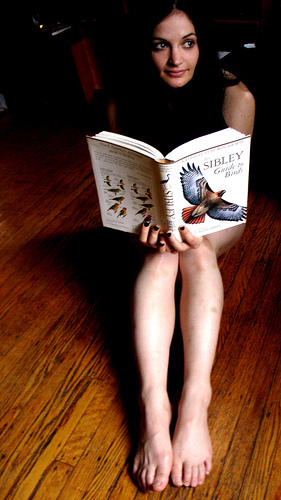
    This lovely young lady is studiously perusing her Sibley guide. Memorizing the fine points of plumage details and field marks in preparation for the upcoming Christmas Bird Counts, no doubt, while trying to visualize the next (and most exciting) addition to her life list. The anticipation of any big event is always half the fun.

    Source: Photo is posted courtesy of Theremina at flickr.com.

    Tuesday, November 21, 2006

    Educating Birds?

    The Council for Environmental Education and Flying WILD have announced a conference (.pdf) entitled Bird Conservation through Education: A National Gathering for Bird Education. What is it, do you suppose, that they hope to teach the birds? I suspect that this conference is actually geared toward bird educators (i.e., people who teach others about birds), not educating birds. Anyway, the conference is scheduled for February 5-8, 2007, at The Crossings in Austin, Texas.

    Hiking Is For the Birds: Creative Fundraising

    Rob Anderson hiked 100 km (62 mi) in 20 hours on April 29th to raise more than $4,000 on behalf of the American Bird Conservancy to help support international conservation efforts for the Cerulean Warbler (one of my favorite birds). Read all about it here. That is one incredible feet (pun intended)! Congratulations, Rob! Your accomplishment should serve as an inspiration to all aspiring bird conservationists.

    Rob's effort was part of the 34th annual One Day Hike sponsored by the Sierra Club.

    List of Known North American Bird Blogs

    In May 2006, I compiled a list of 90 North American bird blogs, which I made available in a blogroll on the right-hand side of Birds Etcetera. I also posted a notice of availability of the list on the BirdChat listserv. Earlier this month, I summarized recent edits to the list, which now stands at 122 blogs.

    To be included on this list, sites must meet the following criteria: (1) the subject matter is primarily or consistently about birds, birding, or birders; (2) the authors are physically located in North America, or write about birds, birding, or birders on that continent; (3) it was active in the past year (i.e., at least one entry); and (4) it is structured in the format of a blog (i.e., dated entries in reverse chronological order).

    My list of known active blogs in the North American birds genre follows in strict alphabetical order:
  • 10,000 Birds
  • A DC Birding Blog
  • A View from the North
  • Adventures in Bird Watching
  • Aimophila Adventures
  • Alan's BirdCam Blog
  • Alis Volat Propiis
  • B and B - Birds
  • Backyard Birder
  • Bay Area Birding
  • Beakspeak - The Big Bird Blog
  • Bill of the Birds
  • Bird brained stories!
  • Bird Notes from West Houston
  • Bird the Planet
  • Bird Traveling
  • Bird Treatment and Learning Center
  • Bird Watchers Notebook
  • Bird Watching: How to Study Birds
  • BirdBlog - ruffling feathers
  • BirdBreath Blog
  • BirdChick Blog
  • birdDC
  • Birder Blog
  • Birders on the Border
  • Birding and Mountain Biking
  • Birding Bytes
  • Birding in Chico
  • Birding in Maine
  • Birding is NOT a crime!!!!
  • Birding Watching in South Florida
  • BirdNote
  • Birds Etcetera
  • Birds of Plymouth Gardens
  • Birdtography
  • Birdwatch
  • Birdwatchin' Buzz
  • BirdWatching
  • Bloomingdale Village
  • bootstrap analysis
  • Boreal Bird Blog
  • BrooklynParrots
  • Carolina Ivorybills
  • Central Park Wildlife Photography
  • Chicago Bird Watching
  • DC Audubon Society
  • Drew's Birds
  • Eureka Nature
  • Feather Weather
  • Field Notes
  • For Elect Eyes Only
  • Hamilton Birding
  • Home Bird Days
  • Home Bird Notes
  • I and the Bird
  • Illinois Birds
  • Introduced Birds Weblog
  • Ivory-bill Skeptic
  • Ivory-bills LiVE!!
  • Jeff Gyr Blog
  • John C. Robinson's Birding Blog
  • Julie Zickefoose
  • Limeybirder
  • Little Big Year
  • Lord Garavin's Bird Blog
  • Mad Birders
  • Maine Birds
  • Marie Winn's Central Park Nature News
  • migrateblog
  • Mike's Birding & Digiscoping Blog
  • My Birding Journal
  • NaturalVisions - Birds
  • Nick K's Weblog
  • Night of the Kingfisher
  • North Coast Diaries
  • Notes from soggy bottom
  • NYC Nova Hunter
  • Ocellated (Birding)
  • Ohio Birding Blog
  • Omar's Birding
  • Operation Migration - In the Field
  • Ornitholature
  • Ornithology
  • PAHawkowl
  • Palemaleirregulars
  • QCbirding2006
  • RaddBlog
  • Ravens in Hollywood
  • Ryan Kulla's Birding Blog
  • San Diego Birding and Photography
  • Saskatchewan Birding, Nature, and Scenery
  • SE Colorado Birding
  • Southwestern Birding Tales
  • Sparroworking - Birds
  • Stercus
  • Stokes Birding Blog
  • Susan Gets Native
  • Swampblog
  • The Birdchaser
  • The Choctawhatchee Search
  • The Chronicles
  • The City Birder
  • The Flycatcher
  • The Hawk Owl's Nest
  • The Incorrigible Birder
  • The Origin of Species
  • The Plover Warden Diaries
  • The Rookie Birder
  • The Urban Pantheist - Birds
  • Thoughts of an Iowa Birdwatcher
  • Today in NJ Birding History
  • Urban Birder
  • Urban Hawks
  • Veracruz Hawkwatch
  • Vermont Bird Tours Blog
  • VINS Conservation Biology Blog
  • WildBird on the Fly
  • Windy City Birder
  • Woodcreeper
  • Woodsong - Avian
  • Words on Birds
  • WPBO
  • Xenospiza
  • I continue to seek additions to this list, so please contact me if you maintain a blog about North American birds, birding, or birders that is not listed above.

    Labels:

    Tuesday, November 14, 2006

    "we're ducks without feathers"

    An excerpt from a very anthropomorphic reflection on the Muscovy Ducks of Lowdermilk Park in Naples, Florida, as published in the Our World section of naplesnews.com on 09/18/2006:
    I didn’t see anything too outlandish about the ducks that humans weren’t guilty of as well. We beg for food. We crowd out native species. We create excessive fecal matter. On a molecular level, the similarities are even more pronounced. Dr. Jeffrey Marcus, assistant professor in the biology department at Western Kentucky University, pointed out that the cellular biochemistry of both Muscovy Ducks and people is almost identical. For instance, in looking at a random strand of duck mitochondria, which controls the conversion of food we eat into energy that the body can use, Marcus found that the genetic sequence of ducks is roughly 77 percent the same as humans. "In the grand scheme of things, we’re ducks without feathers, wings, or beaks," Marcus said. In returning to that first day at Lowdermilk Park, I guess I saw a reflection of myself in that socially inept duck. And DNA analysis aside, maybe we all have a little Muscovy in us – awkwardly wandering around the earth, invading people’s personal space in search of fulfillment and looking for that one person who will accept us.

    Ivory-billed Woodpecker Postage Stamps

    If a country’s willingness to depict one of its most endangered animals on its postage stamps could be used as an indicator of its dedication to bird conservation, then the United States would be hanging its collective head in shame. Looking at the number of postage stamps issued worldwide that have depicted images of the Ivory-billed Woodpecker, we find that:
  • Cuba has issued four stamps (1956, 1961, 1978, 1991), and the
  • United States has issued none
  • In fact, the U.S. has done a pretty poor job of using postage stamps to promote endangered species conservation. By my accounting, the U.S. Postal Service has issued just 20 stamps featuring 11 species of endangered or threatened birds in the last 49 years (and in the 37 years since enactment of the first Federal legislation to protect endangered species in 1969). The species illustrated include:
  • Bald Eagle, 5 stamps
  • Brown Pelican, 4
  • California Condor, 2
  • Whooping Crane, 2
  • Crested Honeycreeper, 1
  • Everglades Kite, 1
  • Hawaiian Goose, 1
  • Peregrine Falcon, 1
  • Piping Plover, 1
  • Seaside Sparrow, 1
  • Wood Stork, 1
  • A special issue featuring members of the Hawaiian honeycreepers of the family Drepanididae would be incredibly beautiful, and would bring much-needed public attention to the fate of these species. To date, only two of the many species in this highly endangered family of birds endemic to the Hawaiian Islands have appeared on postage stamps.

    Monday, November 13, 2006

    Redefining Extinction

    In response to this post at Ivory-bills LiVE!!, which noted an alleged "paucity of evidence for extinction" of the Ivory-billed Woodpecker, I posed this question to cyberthrush:
    I’m curious, cyberthrush. What would you consider to be compelling evidence for 'extinction' of the IBWO (or any other creature, for that matter)?
    Here’s an excerpt of cyberthrush‘s response:
    If the Ivory-bill had truly gone even 60 years with no credible reports it would be discouraging, but it hasn’t. There have been credible reports of Ivory-bills throughout it’s history -- since the 30’s the species has probably never gone even five years without a credible report, i.e., a report that couldn’t be quickly dismissed upon interrogation . . . .
    Cyberthrush’s purported history of "credible reports" of Ivory-bills at least every five years is stunningly at odds with that generally accepted by scientists.

    For example, from the Fish and Wildlife Service’s "official" history of the IBWO (also see here ([.pdf]), we learn that:
    Following the inevitable decline of [virgin] forests [in the southeastern U.S. following the onset of World War II], the last confirmed ivory bill sighting was in 1944 [when artist Don Eckelberry sketched the last known bird in the Singer Tract].

    For [the next] 60 years there were sporadic ivory bill sightings, none confirmed [until the 2004 sightings and video from the White River of Arkansas, which have been disputed by some experts].
    In the end, I guess your willingness to accept reported sightings of Ivory-bills in the 60 years following the last universally accepted photograph depends on how you define "credible" and "confirmed" and how much you want to believe in your heart that Ivory-bills continue to exist.

    In my opinion, the "compelling evidence" pointing to extinction of the Ivory-billed Woodpecker includes the following: (1) lack of physical evidence of any kind (carcasses, feathers, eggshells, or droppings that can be analyzed for DNA), (2) lack of indisputable photographic or video evidence, (3) lack of indisputable vocal evidence, (4) no indisputable evidence of breeding activity, and (5) no sight records reviewed and accepted by bird record committees of any State.

    Saturday, November 11, 2006

    Bird Stamps of the United States

    The 159 U.S. postage stamps depicting birds are illustrated in this wonderful plate, courtesy of Chris Gibbons. Ninety-nine species are depicted on the 159 stamps. The Northern Cardinal appears on ten stamps, the Western Meadowlark on seven, Northern Mockingbird on six, Bald Eagle on five, and the Brown Pelican and Canada Goose on four each. Eight species appear on three stamps, 19 species on two stamps, and 33 species on a single stamp.

    Growing up in the 1960s with a dual interest in birds and stamp collecting, U.S. postage stamps were a disappointment to me. Only three stamps depicting birds had been issued prior to 1960, with another three appearing in the 1960s. I well remember the excitement generated by the issuance of the 4-stamp owl set in 1978. And then came the 50-stamp State birds and flowers issue of 1982. Since the dark days of the 1960s, the U.S. stamp market has become much more rewarding for collectors of bird stamps, with the following numbers being issued by decade: 15 in the 1970s, 69 in the 1980s, 35 in the 1990s, and 34 so far in the 2000s.

    Friday, November 10, 2006

    Quack

    My favorite post-election editorial cartoon, alluding to the lame duck status of President Bush.

    Labels:

    Thursday, November 09, 2006

    All Things Dodo

    In the words of it’s creator, who is known to the world only as Bibi, the dodo, The Dodo Blog "is a blog about dodos in the news, science, culture, art, history, biology, books, media and their influence in the modern culture." This is one of the more fun, innovative, interesting, and unique bird blogs that I’ve run across. Bibi also appears to be the author of Bibi’s box, another entertaining blog that has nothing to do with birds.

    Labels: ,

    Characteristics of North American Bird Blogs: Gender of Authors

    In my attempt to compile a comprehensive list of North American bird blogs, I was concerned only with the content and subject matter of the blogs that I reviewed. I made no conscious effort to include or exclude blogs based on age, gender, or other characteristics of the author(s).

    Of 101 bird blogs (out of 119 total) for which the gender of the author(s) could be determined, 65 were authored by males, 27 by females, and 9 by mixed-sex teams. This preponderance of males among authors of North American bird blogs (by a ratio in excess of 2:1) is surprising.

    According to the 2001 National Survey of Fish, Hunting, and Wildlife-Associated Recreation (.pdf), U.S. females were more likely than males to engage in wildlife-watching activities (54 percent versus 46 percent of the total wildlife-watching population).

    Others can speculate about the reasons for the preponderance of male bird bloggers. I’ll just point out that, although they may be under-represented in number, some of the most prominent of the North American bird bloggers are women; four who immediately come to mind are Laura Erickson, Amy Hooper, Sharon Stiteler, and Julie Zickefoose.

    Labels:

    Characteristics of North American Bird Blogs: Authorship Type

    Blogs can be categorized according their authorship into two types: single-author (the most common) and team or collaborative. Of 119 North American bird blogs considered active as of November 9, 2006 (see here), 106 (89 percent) are single-author blogs and 13 (11 percent) are team or collaborative blogs involving two or more contributors.

    Labels:

    ABA Punts on IBWO Decision

    As reported here, the American Birding Association’s Checklist Committee has decided to postpone an evaluation of recent observations of the Ivory-billed Woodpecker in Arkansas. This is an apparent effort "To avoid further polarization among the ABA membership." While this stance may not be courageous, it is certainly prudent. There's no sense rushing to judgement on this, as more definitive evidence may yet come to light (though I do have to admit to being skeptical).

    Bird Tourism Generates Big Bucks

    Bird tourism can be an economic boon for local communities, as illustrated by these analyses of two Florida birding festivals conducted by the Center for Economic Forecasting and Analysis at Florida State University:
    Florida Panhandle 2002 (.pdf)
    Wakulla Springs 2003 (.pdf)

    Establishing a Birding-Related Business

    Want to escape the rat race and do something you truly enjoy? Then this resource guide (.pdf) from the Texas Agricultural Extension Service may be just for you.

    North American Bird Blogs

    On May 8, 2006, I posted a message to the BirdChat listserv announcing that I had tabulated 90 North American bird blogs, which I had linked to Birds Etcetera. In the ensuing weeks and months I strived to add additional blogs as I became aware of them.

    In the last couple of days, I’ve been working to update the list. My definition of a bird blog is simple: it is a blog that is primarily or consistently about birds, birding, or birders. Many bloggers occasionally post articles about birds, but to be considered a bird blog (in my opinion), birds must be a topic of discussion on a regular basis. Many blogs, especially those that focus on the environment and nature, can be difficult to categorize. Some that I dismissed might well be considered bird blogs by others.

    Starting from an initial list of 126 blogs, 16 were deleted or moved because they are (a) not primarily bird blogs (6), (b) not found (5), (c) not active (2), (d) not a blog (2), or (e) dormant for more than a year (1); and 12 new links were added, yielding a current total of 122 active North American bird blogs (see list at right).

    A summary of recent edits to my list of North American bird blogs:
    Twelve (12) Bird Blogs Added:
  • BirdBreath Blog
  • Birdtogragphy
  • BirdWatching
  • Bloomingdale Village
  • Home Bird Days
  • Introduced Birds Weblog
  • NYC Nova Hunter
  • Omar’s Birding
  • RaddBlog
  • The Choctawhatchee Search
  • Today in NJ Birding History
  • Windy City Birder
  • Ten (10) Bird Blogs Deleted (because they are not really a blog, are not active, can not be found, or have been dormant for more than a year):
  • A Birder’s Journal in East Tennessee (not found)
  • Best Birding Blog (dormant)
  • Birding Gear Big Board (not found)
  • BirdingPal Blog (not really a blog)
  • Crows Really Are Wise (not active)
  • Fledgling Birder/aka Michigan Birder (not active)
  • Mike’s Soap Box (not found)
  • Stuart Healy's Birding Journal (not really a blog)
  • Wild Iowa (not found)
  • "Witchities" World Series of Birding Blog (not found)
  • Six (6) Blogs Moved Elsewhere (because they are not primarily bird blogs)
  • Endment
  • Living the Life Scientific
  • Sarcasm & Science
  • Somewhere in NJ
  • Tortoise Trail
  • Whorled Leaves
  • This list of bird blogs is almost certainly incomplete. If you maintain a bird blog or are otherwise aware of one that I have not listed, please bring it to my attention by way of a Comment.

    Note added 11/09/06: Minor edits were made at 12:55 PM and 2:50 PM EST.
    Note added 11/12/06: Edited by adding two new blogs: RaddBlog and The Choctawhatchee Search.
    Note added 11/21/06: Edited by adding one new blog: Birdtography.

    Labels:

    Monday, November 06, 2006

    The Ivory-billed Woodpecker and the Arkansas Bird Records Committee

    As reported here, the Arkansas Bird Records Committee (ABRC) of the Arkansas Audubon Society reviewed evidence of the existence of the Ivory-billed Woodpecker (IBWO) in the Cache River National Wildlife Refuge in April 2004. Sometime in 2005, they voted to change the status of the bird in Arkansas from "extirpated" to "present." The manner in which unusual or unexpected sightings are handled by the ABRC was explained thusly:
    The Arkansas Audubon Society, which was organzied in 1955, has compiled bird records since its inception. All sightings of species unusual or unexpected in Arkansas must by fully documented (preferably including photographs or videos) and submitted for review by the bird records committee. At least four of the five committee members must vote for acceptance before the sightings become part of the official record. (emphasis added)
    The ABRC maintains the Arkansas Bird Records Database (ABRD). "Since 1986 [the year of publication of James and Neal's Arkansas birds: their distribution and abundance] there have been more than 7,500 significant records contributed to this file." But the current version of the ABRD, which contains records through December 2005, includes no mention of the IBWO. I find this very strange, as the 2004 Arkansas sightings of at least one IBWO were about as unusual or unexpected an occurrence as one could possibly imagine. How can it be that the ABRC considers the IBWO to be "present" in Arkansas (largely on the basis of the Luneau video, I believe) while the ABRD (which is maintained by the ABRC) reflects no accepted records of the IBWO (neither the Luneau video nor any of the seven "compelling" sightings). Something just doesn't compute. What part of the puzzle am I missing?

    Friday, November 03, 2006

    "a little knowledge is a dangerous thing"

    Reports of rare or unusual birds can sometimes lead to mass hysteria, and an observer’s expectations of seeing a rare or unusual bird can lead to self-delusion, resulting in common birds being mistakenly identified and reported as something else entirely (usually the rare bird that the observer was expecting to see). I know this to be true, as it has happened to me (more on that later, maybe).

    Tom Nelson recently brought to light one such case in which a woodpecker sighted in Florida by an amateur birder and initially reported as an Ivory-billed Woodpecker later turned out to have actually been a common Red-bellied Woodpecker.

    This phenomenon is not new. An early example was brought to light by Jonathan Dwight in the April 1918 issue of The Auk. Dwight was one of the founding members of the American Ornithologists’ Union. Clearly, the problem of evaluating sight records is something that ornithologists have had to wrestle with since amateurs and professionals started keeping track of birds and their movements. And it has been the vexation of State bird record committees since their inception. A surprisingly large proportion of the rarities submitted to bird record committees lack these "Minimum considerations for verification of sight records." Which leads one to ask, "How many of Cornell's seven reported Arkansas sightings of Ivory-billed Woodpeckers would have been accepted if submitted to a bird record committee for review?"

    Thursday, November 02, 2006

    The Birder Survey

    Taking a clue from Patrick of The Hawk Owl's Nest, I've taken a crack at completing his birder survey. My responses:

    What state (or country) do you live in? West Virginia, USA.
    How long have you been birding? 42 years (off and on).
    Are you a "lister"? Once upon a time, but not currently .
    ABA Life List: 500+ (or thereabouts), including ca. 230 in Alaska .
    Overall Life List: I have no idea (but it includes additional species seen in the British Isles and Europe).
    3 Favorite Birding Spots: Aleutian Islands, AK; Warren Woods State Park, MI; Point Pelee National Park, ON.
    Favorite birding spot outside your home country: Scotland (the only other country in which I’ve ever really spent much time birding).
    Farthest you've traveled to chase a rare bird: An overnight, round-trip drive from Anchorage to north-central Alaska to see a Red-breasted Sapsucker, the first for Alaska.
    Nemesis bird: White-tailed Ptarmigan.
    "Best" bird sighting: Kirtland’s Warbler (a self-found bird while still in high school).
    Most wanted trip: south Texas in the spring.
    Most wanted bird: Greater Prairie-Chicken.
    What model and brand of bins do you use? Nikons.
    What model and brand of scope do you use? None at present.
    What was the last lifer you added to your list?: Little Blue Heron.
    Where did you see your last lifer? Eastern Panhandle of West Virginia.
    What's the last bird you saw today? European Starling (can't we declare them "illegal aliens" and ship them all back home?).
    Best bird song you've heard ever: Wood Thrush.
    Favorite birding moment: Imagine sitting amongst the jumbled talus of an auklet colony at Buldir Island, Alaska, on a summer evening, with auklets of four species (Parakeet, Crested, Whiskered, Least) whirling about in massive flocks and individual birds sitting briefly atop boulders before entering or departing their nesting cavities, add in Horned and Tufted puffins for good measure, and top it off with a roaring symphony of Steller’s sea lions in the distance. It doesn’t get any better than that.
    Least favorite thing(s) about birding: Mosquitoes, ticks, poison ivy, heat & humidity, and hay fever.
    Favorite thing about birding: The birds!
    Favorite field guide for the US: Robbins (still one of the best, and you can actually carry it into the field with you without feeling over-burdened)
    Favorite non-field guide bird book: Joseph J. Hickey’s A guide to birdwatching.
    Who is your birder icon? Sorry, I can’t settle on just one, so here are several people that I admire. I’d have to put Chan Robbins at the top of the list for bringing us the Breeding Bird Survey and his field guide (the first to cover all North American species in one volume), Roger Tory Peterson for his innovative field guides that I (like most others) slept with and cut my teeth on; and David G. Sibley for his birding skills and artistic talent and for standing up to the Cornell establishment regarding the supposed identification of an Ivory-billed Woodpecker in Arkansas.
    Do you have a bird feeder(s)? No.
    Favorite feeder bird? Red-breasted Nuthatches (when I did have feeders) gathering peanut butter to carry back to their young. And flying squirrels!

    Crow Trends in West Virginia

    In a recent post about corvids, John of A DC Birding Blog commented about the susceptibility of American Crows to West Nile Virus (WNV). Using information from the Christmas Bird Count, he demonstrated a decline of about 50 percent in early-winter abundance in the Mid-Atlantic States of Delaware, Maryland, and Virginia, from about 14 birds/party-hour in 1992 to about 7 birds/party-hour in 2005.

    In striking contrast, early-winter populations of American Crows in West Virginia (as indicated by the number of birds counted/party-hour) have increased dramatically over the same time period, especially since 2002, and an apparent 5-fold increase since the mid-1990s (left-click on the graph below to enlarge). Also, crows appear to be relatively more abundant in West Virgina by an order of magnitude.


    The same general trend is also evident when we graph the actual number of birds counted (below).


    The reason(s) for the dramatic differences in population trends between the two adjacent regions is not obvious, but would certainly seem to merit additional investigation. Are the birds wintering in these regions from different breeding grounds in which susceptibility to WNV differs? Have crows shifted their wintering grounds westward for reasons unrelated to WNV? Is WNV less prevalent in West Virginia than in the Mid-Atlantic States? As is so often the case, this comparison raises many more questions than answers.

    Labels:

    Survey of Bloggers

    Sarah Pedersen of The Robert Gordon University's Aberdeen Business School in Aberdeen, Scotland, is conducting a comparative survey of the blogging habits of people in the U.K. and U.S. Incredibly, I somehow became one of the 50 U.S. male bloggers chosen to participate in the survey. See Dr. Pedersen’s blog, Validation, to learn more about her project and some of the initial findings.

    Note added 11/07/06: In the original post, Dr. Pedersen's last name was incorrectly rendered as Ferguson, an error for which I apologize and which has now been corrected.

    Flattery Will Get You Recognized

    Dorothy Borders of the Backyard Birder blog recently posted an entry entitled "Checking out the competition," wherein she reviews some of her favorite blogs about birds and birding. I was very flattered to find Birds Etcetera mentioned prominently among some of the leading luminaries of the bird-blogging world. Here’s an excerpt:

    A couple of the top blogs on my list of favorites are by two Johns. The first one is A DC Birding Blog that addresses both local DC as well as national and international birding news. He has an entry on the Ivory-billed story also.

    John Trapp of West Virginia writes the second blog. It's called Birds Etcetera AKA Bird Stuff. He's a good writer and always an enjoyable read and, like the other John, he pretty much covers the universe of birding [emphasis added].
    Thank you, Dorothy, for this unsolicited (I swear!) flattery; my high school English teacher would be proud. I hope that I can live up to the billing.

    Friday, October 27, 2006

    Pigeon Wars

    This article from the New York Times Magazine (may require registration, but it’s simple and free) about holistic approaches to controlling pigeon populations is really quite bizarre. I loved the characterization of one segment of the pigeon-feeding public as crazed older women who resort to working as "phone-sex operators and prostitutes" to earn money to buy bird seed because they have been transformed by the pigeons through some magical co-evolutionary process into their "senseless disciples." That's hilarious!

    But on further searching, I see that PiCAS (the Pigeon Control Advisory Service) is actually for real; they even have a supporter in the U.S. And a Dr. Haag-Wackernagel really has conducted scientific studies on the control of pigeons in Basel, Switzerland, and published his results in such outlets as Nature and the Wildlife Society Bulletin.

    Cities Lay Claim to Birds

    From ePodunk comes this list of bird slogans adopted by cities proud of their associations with various species of birds. It looks like Berryville, Arkansas (cited here), has some competition for the title of Turkey Capital.

    Labels:

    Turkey Capital of the World

    That self-appointed honorary title goes to the town of Berryville, Arkansas.

    SORA Redux

    I recently expressed my increasing level of frustration at trying to use SORA—The Searchable Ornithological Archive to download literature, mostly in vain. I serendipitously discovered, thanks to a tip provided on a seabird conservation plan developed by the U.S. Fish and Wildlife Service, a way around the downloading problem. Just follow these four simple instructions:
  • Right-click on the document of interest
  • Left-click on "Save target as ..."
  • Left-click the Save button to download
  • Left-click the Open button to view the document on your desktop
  • I have used this procedure successfully to download and view documents as large as 42.8 MB. SORA administrators could relieve their users of much agony and frustration if they would just post these simple instructions prominently at the top of their home page.

    Labels:

    Friday, October 06, 2006

    Frustration Trumps Utility: SORA Fails to Live Up to Potential

    SORA—The Searchable Ornithological Research Archive "is an open access electronic journal archive, and is the product of a collaboration between the American Ornithologists' Union, the Cooper Ornithological Society, the Association of Field Ornithologists, the Wilson Ornithological Society, and the University of New Mexico libraries and IT department."

    Contents of the following ornithological journals (and years) are available in searchable and browseable formats:
    Auk (1884-1999)
    Condor (1899-2000)
    Journal of Field Ornithology (1930-1999)
    North American Bird Bander (1976-2000)
    Pacific Coast Avifauna (1900-1974)
    Studies in Avian Biology (1978-1999)
    Wilson Bulletin (1889-1999)
    Contents of the following journals (and years) are available in browseable formats only:
    California Birds/Western Birds (1970-2004)
    Ornithological Monographs (1964-2005)
    Ornitologia Neotropical (1990-2002)
    SORA is of inestimable potential value in that it promises to make available on every ornithologist’s computer desktops a healthy percentage of the published scientific literature on North American birds of the last 120 years. Thus far, however, it has failed to deliver on its promise.

    In my experience, the potential utility of SORA is all-too-often trumped by the frustration experienced in trying to download literature from the database. Time after time in the past year I have tried to download PDF files (from three different PCs) only to have the browser lock up part way through the download.
    I don’t recall having this problem with SORA when it initially came online. In fact, I used it successfully to search, view, download, and print literally dozens of historical documents for a project that I was working on two years ago. This download problem is something that has just cropped a little more than a year ago. The administrators at SORA are acutely aware of the problem. In fact, the Help section of their Web site notes that "Another common problem [when attempting to view Adobe Acrobat files] is for a file to begin downloading, but lock up before completing the download." (emphasis added)

    I have downloaded hundreds of PDF documents from dozens of Web sites and don’t recall ever having a file lock up in the middle of downloading. In my experience, that is a circumstance unique to SORA, where it has become a frequent (even expected) occurrence. I just wish that SORA and its collaborative partners would work together to fix this problem so that SORA's potential as an invaluable online resource to ornithologists and other avian researchers could be fully realized.

    Are there others out there who are experiencing the same frustrations? If you've found a solution to this problem, I'd appreciate it if you would share it with me!

    Thursday, October 05, 2006

    Of Birds and War

    The American Enterprise Institute for Public Policy Research (AEI), an ultra-conservative right-wing think tank, is about the last place I would expect to find an article on birding (to see why I would make such a statement, check out AEI’s pro-business perspectives on environmental issues that have appeared in their Environmental Policy Outlook series, an in-house bimonthly newsletter on “environmental policy”).

    But here it is, a review of Jonathan Trouem-Trend’s Birding Babylon blog (and now book of the same name) by Christopher Griffin that was originally published in the Blogs of War section of the Armed Forces Journal.

    My favorite treatise on the folly of warfare (and, very indirectly, birds) is Farley Mowat's And No Birds Sang, an account of "the terrible reality of war" based on his own experiences as a combat infantryman in Europe during World War II. This is one book that should be required reading of any gung ho boy or girl contemplating joining the military. The other is Johnny Got His Gun, by Dalton Trumbo.

    Thursday, September 21, 2006

    More Hyperbole from Tim Gallagher

    Tim Gallagher is the man who gave us perhaps the most overused metaphor in birding and ornithological history. I refer, of course, to terms such as “The Grail Bird,” “holy grail of birdwatchers,” and “ornithologist’s holy grail” applied to the Ivory-billed Woodpecker. Was this metaphor ever applied to the Ivory-billed Woodpecker (or any other bird, for that matter) prior to the Cornell Lab or Ornithology’s announced rediscovery of that species in April 2005? If it was, it certainly escaped my attention. No, this is marketing at its very best, pure and simple.

    Now we have this incredible bit of hyperbole attributed to Gallagher:
    Apparently when National Public Radio broke the story of the rediscovery on April 25, 2005, hundreds of people across the United States who were on their morning commute had to pull over to the side of the road—they were crying and couldn’t see well enough through their tears to drive [emphasis added].
    --As quoted in this article in the Jackson Hole (Wyoming) Star-Tribune announcing his appearance at a speaking engagement at Casper College.
    Whew! I think I need to go dig out my hip boots after that one.

    Thanks to Tom Nelson at the Ivory-bill Skeptic blog for bringing this article to my attention.

    “Hybrid Mutant of Something”

    An unidentified creature found dead in Turner, Maine, is believed to be the “mysterious animal with chilling monstrous cries and eyes that glow in the dark” that “has mauled dogs, frightened residents, and been the subject of local legend for half a generation.”

    Curiously, “Wildlife officials and animal control officers declined to . . . examine the remains,” leaving us with just this photograph to speculate about the possible identity of the animal.

    Because a positive identification was not made, speculation about the animal and its origins will probably be discussed in cryptozoological tracts for decades. From such seemingly innocuous events are legends born.

    Friday, September 15, 2006

    Birds and Trees: An Inseparable Attraction

    Let your mind wander to birds and you will invariably also think of trees, especially in eastern North America, where forests and forest-nesting birds dominate the landscape. The two kinds of organisms (birds and trees) are nearly inseparable. In ecology, symbiosis is the term used to describe an interaction between dissimilar organisms living together in a more or less intimate association. Ecologists have categorized several different types of symbioses depending on how the organisms interact and whether one or both of the organisms benefit from the association.

    Commensalism is an association in which one organism benefits while the other is not affected. This is perhaps the normal relationship between birds (benefit) and trees (not affected). Trees benefit birds in numerous ways: they provide (1) ready perches for displaying, feeding, mating, preening, resting, and sleeping; (2) display posts from which to announce territories and advertise for mates; (3) branches and limbs for supporting nest structures; (4) micro-habitats—from bark to flowers to leaves—that harbor a wide variety of insects and other animals that the birds prey upon; (5) direct sources of food in the form of berries, buds, flowers, nectar, nuts, sap, or seeds; (6) crevices, nooks, and crannies in which to conceal and store food; (7) watching and listening posts from which to scan their surroundings for predators or prey; (8) shelter from wind, weather, and predators; and (9) cavities for nesting and roosting.

    Mutualism is an association that is advantageous to both organisms. In the case of birds that feed on the berries, nuts, or seeds of trees, the relationship between birds and trees may be truly mutualistic. The birds benefit the trees by scattering the seeds of the trees far and wide. In many cases, tree seeds are more likely to germinate if they have first passed through the digestive tract of a bird. The importance of seed distribution by birds has been known for some time, and is currently the focus of a study on regeneration of tropical forests. Populations of insect-eating birds are known to increase in response to outbreaks of forest pests. Thus, in their role as insect predators, birds may benefit trees by helping to reduce the potentially devastating impacts of defoliating insects such as the spruce budworm (.pdf). The potential economic benefits of insectivorous birds was, in fact, one of the original arguments put forth for justifying passage of the Migratory Bird Treaty Act in 1918.


    The FatBirder's Nest
    FatBirder Web Ring